
December 6, 2025

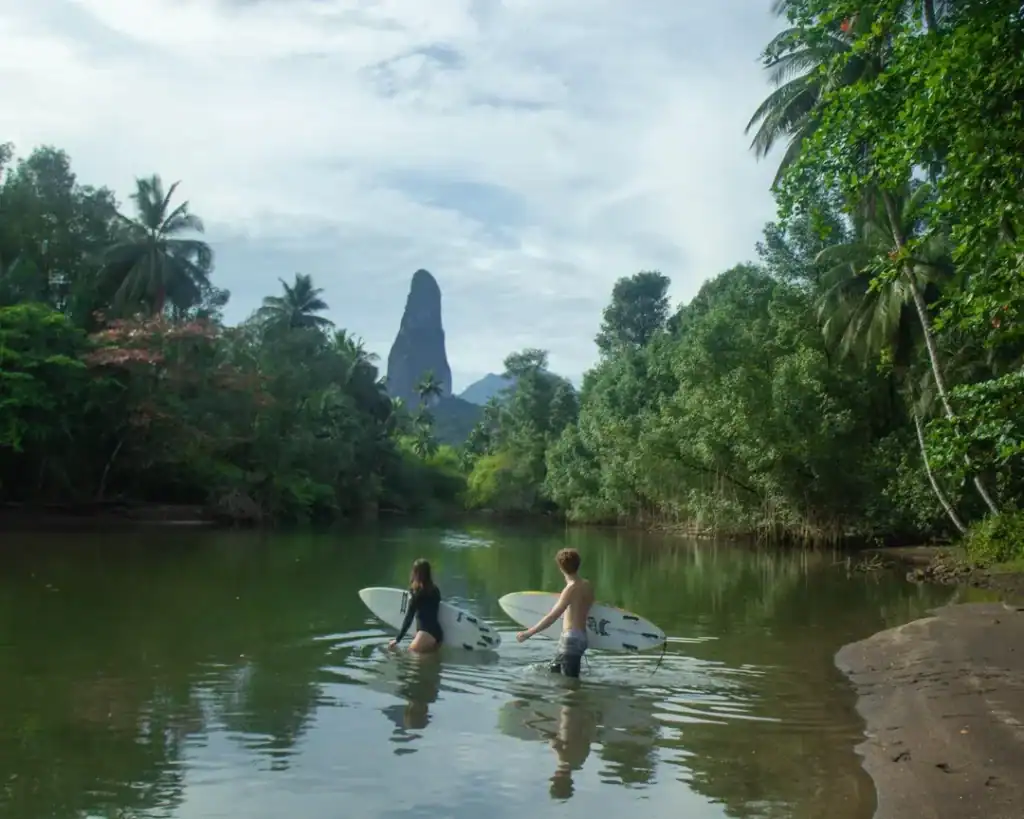
Pico Cão Grande in São Tomé is the most recognisable volcanic feature on the island. Rising to 663 metres (2,175 ft) above sea level, the tower emerges from the southern rainforest inside the [Obô Natural Park] and forms a near vertical needle of phonolite above dense jungle. For most visitors it is the defining image of the south. The peak itself is not a hiking summit, but the trek to its base is one of the most rewarding rainforest walks in the region. For many travellers, the Pico Cão Grande trek becomes the highlight of their time in São Tomé.
This guide explains how the volcanic tower formed, the wildlife that surrounds it, the documented climbing history, and the practical steps needed to reach the viewpoints and the Agripalma access point via the EN-2 road from [São Tomé city]
| Pico Cão Grande – Key Information | Details |
|---|---|
| Location | Southern São Tomé, inside the Obô Natural Park buffer zone, near Agripalma Plantation off the EN 2 road. |
| Elevation | Summit at 663 metres (2,175 ft) above sea level, rising sharply from lowland rainforest. |
| Landscape | Vertical phonolite tower above dense primary and secondary rainforest, with frequent cloud cover around the peak. |
| Best Season | Main dry season from June to August for clearer views and firmer ground, shorter dry window in January and February. |
| Experience Type | Guided rainforest trek to the base of Pico Cão Grande, not a summit hike and not a prepared tourist trail. |
| Trek Duration | Roughly 3 to 6 hours return, depending on rain, mud and group pace. |
| Difficulty | Challenging jungle hike with mud, roots, fallen logs and a river crossing, suitable for reasonably fit walkers. |
| Access Route | Drive south from São Tomé city along the EN 2 to Agripalma Plantation, then continue on plantation tracks to the forest edge. |
| Viewpoints Without Trekking | Roadside views from the EN 2 near Agripalma and Dona Augusta, usually accessible year round even in heavy rain. |
| Wildlife Highlights | Primary rainforest with orchids, large begonias, São Tomé cobra (Naja peroescobari), endemic birds and tree frogs. |
| Hazards | Deep mud, slippery roots, rising river after rain, dense vegetation, presence of a venomous endemic cobra. |
| Guide Requirement | Local guide is essential for access through private plantation land, navigation and safety inside the forest. |
| Ideal For | Travellers who want a genuine rainforest experience, are comfortable with mud and humidity, and are happy with a base trek rather than a summit. |

Pico Cão Grande is the exposed core of an ancient volcanic vent. Over millions of years, tropical weathering stripped away the softer outer cone and left the hard central plug standing on its own. This explains the tower’s near-vertical faces and its isolated position despite a summit of only 663 metres above sea level. The rock is phonolite, a dense volcanic material that erodes slowly and holds moisture. Warm, humid air rising from the south coast condenses against the tower and creates a shifting cloud cap that opens and closes throughout the day, which is why clear views of Pico Cão Grande often appear in short weather windows.

The base of Pico Cão Grande lies within the wider rainforest system of the Obô Natural Park, one of the most biodiverse areas in the Gulf of Guinea. The approach passes through secondary forest before reaching intact primary rainforest, where constant moisture supports thick carpets of moss, orchids, ferns and large shade-tolerant begonias. The forest remains wet year round, even during the dry season, creating a cool, humid microclimate beneath the tower. This environment is also home to several endemic species, including the São Tomé cobra, rare forest birds and tree frogs, all of which form part of the natural character of the trek.
The forest floor around Pico Cão Grande is thick with ferns, vines and mosses. As you move closer to the base of the tower, the vegetation shifts to species that tolerate lower light and higher moisture. Large endemic begonias root in deep soil pockets on the slopes, and orchids grow directly on the damp rock and fallen logs. The terrain stays wet throughout the year, even in the dry season, and the ground can feel spongy underfoot from constant leaf litter and rainfall.
The rainforest surrounding Pico Cão Grande supports several endemic species that are typical of the island’s interior. The most notable is the São Tomé cobra, Naja peroescobari, a native elapid that forms part of the normal forest ecosystem. Encounters on guided treks are uncommon, but visitors must stay on cleared paths and follow instructions, as the snake is venomous and vegetation can be dense near the tower. The canopy above holds São Tomé Olive Pigeons, African Grey Parrots and Giant Sunbirds, while the forest floor and stream edges support local frogs and small mammals. Together, these species contribute to the distinct character of the approach trail and reflect the biological richness of the Obô Natural Park.
Only a small number of specialist big wall climbers have summited Pico Cão Grande. The combination of moisture, vegetation and the rock surface makes it one of the most challenging climbs in the region. The history below reflects documented and verifiable ascents.
A mixed Portuguese and Santomean team reached the summit shortly after independence. Their approach relied on heavy, improvised equipment. The goal was to prove that reaching the top was possible rather than to establish a repeatable route.
In February 1991, a Japanese team led by Yosuke Takahashi, with Kenichi Moriyama and Naotoshi Agata, completed the first technical ascent using recognised big wall methods.
• Approx. 400 metres
• Aid and trad climbing
• Wet conditions throughout
This ascent demonstrated that the tower could be climbed using standard techniques, though conditions remained difficult.
In June 2016, climbers Gareth Leah and Sergio Almada established a new line named Nubivagant on the east face.
• Approx. 455 metres
• Fifteen pitches
• Difficulty around 5.13d (F8b)
• Frequent wet rock and vegetation on the route
The climb set a modern benchmark for difficulty on the tower.
In July 2018, the Spanish climbers Iker Pou and Eneko Pou, with Manu Ponce and Jordi Canyi, established Leve Leve, the hardest documented route on the tower.
• Approx. 450 metres
• Difficulty around 5.14a (F8b plus)
• Ground up style
During the same expedition, they also completed the first all free ascent of Nubivagant. This confirmed the peak’s potential for high grade climbing during brief dry periods.
In 2019, an all-female team led by climber Sasha DiGiulian, with Angela Vanwiemeersch and Savannah Cummins, completed a ascent of Pico Cão Grande during a period of unstable weather. Their goal had been to make a female ascent of one of the major routes established in previous years, but conditions forced the team to adapt their plan on the wall. The expedition drew international attention to the peak and highlighted how serious the climbing remains, even for experienced big wall teams. Read the full Red Bull article here.
The climbing history shows why Pico Cão Grande is not a trekking summit. Even expert climbers face wet rock, slippery biofilm, vegetation inside holds and weather that shifts within minutes. For normal visitors, the appropriate experience is the trek to the base.

The dry season from June to August offers the best trekking conditions and more reliable views of Pico Cão Grande. January and February provide a shorter dry window with hotter temperatures. Rain from September to May creates deep mud, reduces visibility and makes the river crossing more difficult.
The standard visitor experience is the trek through secondary and primary forest to the base of the tower. The trail is unmarked and passes through muddy sections, roots, fallen logs and a river crossing. For travellers who enjoy wild trails and genuine rainforest, this is one of the island’s most memorable walks.
Conditions
The ground is wet year round. Vegetation grows fast and sections of the path shift over time. Guides clear the route where required.
Duration
The trek normally takes 3 to 6 hours return, depending on rainfall and group pace.
Why a Guide Is Required
A guide is necessary because:
• access is through private plantation land
• the forest trails are not signposted
• wildlife awareness is important
• the river can rise after rain
• losing the route is easy without local knowledge
The EN 2 highway provides excellent roadside views of the tower. The best vantage points are near the entrance to Agripalma Plantation, close to the small settlement of Dona Augusta. Morning light often offers the clearest views of Pico Cão Grande. The viewpoint remains accessible even in heavy rain, making it the most reliable option when trail conditions are poor.
Road Access
Visitors travel south from São Tomé city along the EN 2 highway. The approach to the peak is marked by a clear view across Agripalma’s plantation land. This is the easiest place to stop for photographs of Pico Cão Grande. Find out about our car hire or tours to the South here.
Starting the Trek
Guided treks begin inside Agripalma Plantation. Plantation tracks lead toward the forest edge, where the unmarked jungle path begins. A 4×4 is recommended, especially after rain.
Travel Time
Most visitors reach the starting point in 1.5 to 2 hours depending on road conditions.
The trek suits visitors who want a real rainforest experience and feel comfortable with mud, uneven ground and humidity. It is not suitable for travellers seeking an easy or dry walk. The reward is standing directly beneath one of the most distinctive volcanic features in West Africa.
Pico Cão Grande is a landmark that defines the south of São Tomé. Travellers can view it from the EN 2 road or join a demanding trek through rainforest to the base. Its ecology, geology and climbing history make Pico Cão Grande a uniquely important feature of the island. The correct visitor experience is the journey to the base rather than the summit. The trek is challenging and wet, but ideal for visitors looking for a genuine rainforest trail rather than a prepared walking route.
Need Advice?